Two days can feel like a week. This small-group tour strings together Cu Chi Tunnels and the Mekong Delta in a way that works well when you’re short on southern Vietnam time. You’ll ride in a private vehicle, get guided context for both the war and daily river life, and sleep overnight in Can Tho so the whole trip doesn’t feel like a blur.
What I like most is the balance: you get both the hard history at Cu Chi and the gentler rhythm of the delta. I also love the early Cai Rang start paired with the boat-and-bicycle activities—so you’re not just watching from a distance. One thing to keep in mind is the “3-star-ish” reality: you’re choosing between a 4-star hotel or a village homestay, and at least some recent stays have been described as needing repair, even if the location is convenient.
You’ll also get real human storytelling. In past trips, guides such as Tri, Rose, Tony, and Ryan have been specifically praised for making the history clear and adding everyday customs along the way, while the drivers handle the traffic details that can otherwise grind your day down. If you’re hoping for a super-flexible schedule, this is still a guided, timed itinerary—so you’ll want to be ready to move when the group moves.
In This Review
- Key reasons this trip works
- Two days that stitch Cu Chi to the Mekong Delta
- Price and what you actually get for $320
- Private pickup, small-group rhythm, and how the days feel
- Cu Chi Tunnels: what you’ll see at Ben Duoc and why it matters
- Mekong Delta views on the way to Cai Rang
- Cai Rang Floating Market at 6:30: fruit, boats, and real pace
- The boat to the noodle and rice paper factory
- Biking the orchard and watching fishing life
- Lunch, Kimmy Chocolate Factory, and the ride back to Ho Chi Minh City
- Where you sleep in Can Tho: hotel choice and what to expect
- Who should book this Cu Chi and Mekong tour
- Should you book this tour or build your own route
- FAQ
- How many people are in the group?
- What time do you get picked up on day one?
- What time do you get picked up for Cai Rang floating market?
- What meals are included?
- Is transportation included?
- Are entrance fees and tickets included?
- Do you take a boat during the trip?
- Do you bike on this tour?
- What are the overnight options in Can Tho?
- Is there a chocolate tasting stop?
- What’s the cancellation window for a full refund?
Key reasons this trip works
- Small group (max 10) means you’re not stuck at the back of a crowd
- Cu Chi Ben Duoc tunnels plus Mekong Delta views in one continuous day
- Cai Rang at the early hour (around 6:30) for a fruit-focused market experience
- Boat + noodle/rice paper factory makes the food story feel hands-on
- 30-minute bike ride through orchards gives you a break from boats and vehicles
Two days that stitch Cu Chi to the Mekong Delta
This tour is built for the traveler who says, I need a lot of Vietnam, fast, but I still want it to feel grounded. You start with a deep dose of history at Cu Chi, then you switch gears to the Mekong—rivers, canals, boats, and markets that still shape daily life. The overnight in Can Tho is the secret sauce. It gives you time to breathe in the delta instead of rushing everything back to Ho Chi Minh City.
Price-wise, $320 per person sounds like a big number until you look at what’s bundled. You’re not just paying for “sightseeing.” You’re paying for private transportation, guide time across two days, admissions, a boat trip, two breakfasts, two lunches, and an included overnight stay at either a 4-star hotel or an optional village homestay. When you compare that to the cost of booking each segment separately (driver + tickets + meals + hotel), the structure starts to make sense.
Price and what you actually get for $320
Here’s where value shows up. First: private transport. The route between Ho Chi Minh City, the Cu Chi area, and the delta is not a quick hop. A group this small (up to 10 people) also matters because you can ask questions without shouting over a busload of people.
Second: meals and tickets are included. The tour lists two breakfasts and two lunches, plus admissions and experiences such as the boat ride connected with the factory visit. Mineral water is also included, which is the kind of small detail that saves you from paying for bottles every few hours.
Third: the overnight is not an add-on. You’ll sleep in Can Tho as part of the package—either in a 4-star hotel or an optional homestay. That’s a big deal for anyone trying to optimize time and energy. You’re not spending your second day simply “getting back,” and you’re not losing half a day to check-in logistics.
The only “cost” you pay is time discipline. You’ll have early pickups (7:30 on day one, 6:30 on day two). If you’re the kind of traveler who needs a leisurely start to function, this tour will ask you to tighten your morning routine.
Private pickup, small-group rhythm, and how the days feel
The tour begins with hotel or preferred-location pickup around 7:30 a.m. on day one. You’ll return to the meeting point area in Ho Chi Minh City at the end of the tour. Everything else is about timing and flow: you’re moving through several areas across two days, with each stop planned to avoid feeling like wasted transit.
In reviews, people have mentioned comfort details like a clean van, working air-conditioning, and even WiFi on board on some departures. That’s not something you should assume on every single trip, but it lines up with the “private vehicle” promise: you’re not stacked into an uncomfortable ride while you wait in traffic.
Most days in Vietnam include traffic. What makes this easier is that you’re not navigating your own route. The driver handles the road chaos so you can focus on the guide’s story and the scenery outside the window. Past guests even credited drivers for their skill at threading through Vietnamese traffic.
Cu Chi Tunnels: what you’ll see at Ben Duoc and why it matters
You’ll spend your morning at the Cu Chi Tunnels, with the plan to explore Cu Chi Ben Duoc—described as the less touristy part compared with more famous entry points. The big benefit here is that you still get a strong, memorable experience without feeling like you’re in a nonstop theme-park queue.
What you’re really buying is perspective. Cu Chi isn’t just a set of tunnels; it’s a lens on how people adapted under extreme conditions. On past tours, guides like Tony and Rose have been praised for giving context not only about the Vietnam War, but also about culture and customs that sit alongside that history.
You can expect guided walking through the tunnel area and time to take in demonstrations and explanations from your guide. The tour includes admission tickets, so you’re not stuck handling entry paperwork. If you’re sensitive to tight, enclosed spaces, remember you’ll be in underground sections; it’s wise to plan for claustrophobic moments even if the experience is otherwise well-paced.
After the tunnel visit, you head onward toward the Mekong Delta. You’ll also have lunch at a local restaurant during this first day. That lunch matters because it breaks up the travel and gives you a chance to switch from “war context mode” into “food and river mode.”
Mekong Delta views on the way to Cai Rang
Once you’re on the delta route, the scenery changes fast. The Mekong area is full of boats, houses, and market life on waterways and canals. Even before you reach the floating market itself, the journey sets expectations: this is water-based living, not just a day trip to a countryside viewpoint.
The tour’s structure helps you not miss the mood. You’re not simply dropping in for photos and leaving. You’re traveling with a guide who frames what you’re seeing—so the delta feels like a system, not a postcard.
In my view, this is one of the smartest choices for time-poor visitors. You get Cu Chi early, then you gradually shift into Mekong rhythm rather than switching abruptly from tunnels straight into a late-morning market crowd.
Cai Rang Floating Market at 6:30: fruit, boats, and real pace
Day two starts early: pickup is around 6:30 a.m., and the drive to Cai Rang Floating Market takes roughly 40 minutes. This matters. Markets at this hour have more energy and less heat, and you’re more likely to see the rhythm of buying and selling as it’s actually happening.
Cai Rang is where the tour leans into sensory specifics. You’ll have the chance to try fruits such as mangoes, durians, or pineapples. That small detail is surprisingly important because it keeps you from treating the market like a photo shoot only. If you like food experiences, this is a strong payoff.
The market visit is guided, but it’s not an over-scripted performance. You can look at boats, cargo, and the way people organize around the water. Your guide adds context and keeps you pointed at what’s most meaningful.
If you’re worried about “floating market fatigue” (seeing the same stalls, same angles), this tour is at least trying to solve that with early timing and then immediately continuing to other activities like the factory visit and orchard biking.
The boat to the noodle and rice paper factory
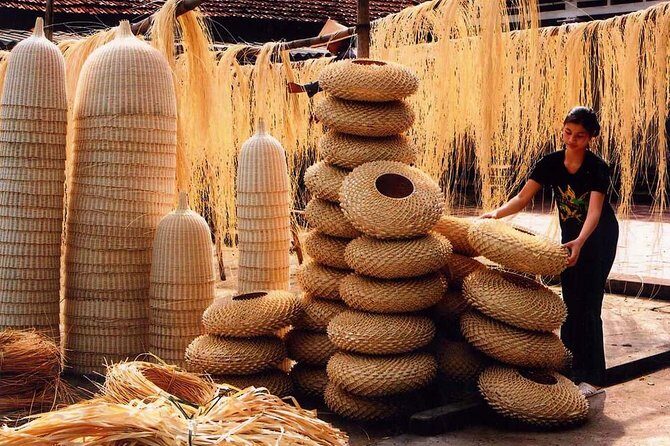
After the floating market, you’ll take a boat to a noodle and rice paper factory. This is one of the most practical stops in the whole tour. Instead of only watching commerce, you get a glimpse of production—how locals make traditional foods you might otherwise just buy off a shelf.
The tour includes a boat ride of about 10 minutes to reach the factory area. Once you’re there, you’ll discover how these products are made. You’re not just told. You can actually watch the process as your guide walks you through what you’re seeing.
This is also a good break in pace. After the morning market and before the biking and orchard time, the factory visit gives structure. It helps you understand the “why” behind the foods that show up across the delta—noodles and rice paper aren’t random ingredients; they’re part of daily meals and local supply chains.
Biking the orchard and watching fishing life
Next comes the part that often becomes the favorite for active travelers: a fruit orchard stop plus a 30-minute bike ride through the countryside. The tour frames this as a way to leave the main tourist trail and experience local life. Even with that goal, the biking time is short enough to feel doable for most people who can ride a bicycle.
You’ll also be re-fueled afterward with tropical fruits and tea, plus time to observe fishing activities. This is where the day shifts from “activity” to “watch and absorb.” You’re not locked into another big site. You’re in a rural setting where you can notice how the day works around water and food.
A practical note: wear comfortable shoes and keep hydrated. You’ll have morning walking, outdoor time, and then biking, so your comfort matters more than you’d think.
Lunch, Kimmy Chocolate Factory, and the ride back to Ho Chi Minh City
Around 11:00 a.m., you’ll enjoy a Vietnamese lunch at a local restaurant on the way back toward Ho Chi Minh City. After lunch, the tour includes a stop at the Kimmy Chocolate Factory, where you can try chocolates in different flavors for free.
That chocolate stop is small, but it’s a smart final touch. By the time you reach it, you’ve already done tunnels, markets, boats, and biking. A sweet tasting becomes a reset button, not an extra “thing” you’re forced to power through.
Then you head back to Ho Chi Minh City. The tour ends back at the meeting point area, which keeps it simple if you’re planning onward travel or dinner.
Where you sleep in Can Tho: hotel choice and what to expect
Overnight in Can Tho is included. The offer is either a three-star or 4-star hotel option (listed as 3-star in the overview and 4-star in the inclusions) or a village homestay if you choose it. This is a place where the “value” part can swing depending on what you select.
If you pick a hotel, you’re trading for convenience and a more standard setup. Recent notes mention a central location that makes it easier to explore Can Tho at night, even if the property may need repair.
If you pick a homestay, you’re choosing a cultural format. The tour data says it’s optional, so you should align it with your comfort level—homestays are a great experience for travelers who like being close to daily life, and they’re less ideal if you need a very predictable room setup.
Either way, having an included overnight is the kind of planning win that makes this tour work as advertised. You’re not trying to do too much with one sleepless night.
Who should book this Cu Chi and Mekong tour
This tour is best for you if:
- You want Cu Chi and the Mekong Delta in just two days without complex logistics.
- You enjoy guided context that connects the Vietnam War to everyday culture.
- You like active breaks: there’s 30 minutes of biking and plenty of movement through market and dock areas.
- You travel in a style where early mornings don’t ruin your day.
This might not be ideal if:
- You strongly dislike early starts (6:30 and 7:30 are non-negotiable in this plan).
- You need a totally flexible schedule. This tour runs on time blocks.
- You’re very sensitive to underground spaces, since the tunnels are part of the core experience.
The group size cap of max 10 is a big plus. It’s a sweet spot between solo independence and full coach anonymity. You’re more likely to get your questions answered and not feel like you’re trapped in a long line.
Should you book this tour or build your own route
If you’re doing southern Vietnam fast, I’d lean toward booking this. It’s one of those rare packages where the included pieces actually fit together: private transport, guided history, an early market start, a production stop, short biking, and an overnight that prevents day-one/day-two overlap from becoming misery.
The main reason I’d still hesitate is the lodging variability. If you’re the kind of traveler who hates any hint of a “needs repair” room, choose the hotel carefully (or consider whether a homestay aligns better with your comfort). Also, if you hate being outdoors in the morning heat, you’ll want to plan accordingly because Cai Rang is early for a reason.
Overall, for value-per-decision, this is a strong pick: you buy a complete two-day story of southern Vietnam, and you don’t have to coordinate the transport yourself.
FAQ
How many people are in the group?
The tour is limited to a maximum of 10 travelers, which helps keep the experience more personal.
What time do you get picked up on day one?
Pickup is at around 7:30 a.m. from your hotel or preferred location in Ho Chi Minh City.
What time do you get picked up for Cai Rang floating market?
Pickup is at around 6:30 a.m. on day two.
What meals are included?
The tour includes two breakfasts and two lunches.
Is transportation included?
Yes. You get private transportation in a comfortable vehicle, plus a knowledgeable English-speaking guide and driver.
Are entrance fees and tickets included?
Yes. Entrance fees, tickets, and the boat trip are included as listed in the package.
Do you take a boat during the trip?
Yes. After visiting Cai Rang, you take a boat to the noodle and rice paper factory.
Do you bike on this tour?
Yes. After the factory stop, you arrive at a fruit orchard and spend about 30 minutes biking around the countryside.
What are the overnight options in Can Tho?
You can choose between a 4-star hotel option or an optional village homestay.
Is there a chocolate tasting stop?
Yes. On the way back to Ho Chi Minh City, you visit Kimmy Chocolate Factory, where you can try chocolates for free.
What’s the cancellation window for a full refund?
You can cancel up to 3 days in advance of the experience for a full refund, as long as you cancel at least 3 full days before the start time.