Saigon feels easier when someone local paces it with you. This walking tour by Joy Journeys mixes major District 1 sights with university student guides who share what the city means to them. It is less lecture mode and more real conversation as you move street to street.
I especially like the maximum 6-person group vibe, so you get time to ask questions instead of shouting over a megaphone. Two other wins: the tour includes bottled water plus a cup of Vietnamese coffee (Ca Phe Sua Da), and it takes you into the Secret Weapons Cellar where the Vietnam War story becomes physical, not theoretical.
One thing to keep in mind: it depends on good weather, and you are on your feet for about 3 hours 15 minutes, so comfy shoes and sun protection matter.
In This Review
- Key things to know before you go
- A walking tour where university guides do the talking
- Price and timing: 3 hours 15 minutes for $14 worth of value
- The route: central sights plus war memory you can actually see
- Stop 1: Notre-Dame Cathedral Basilica of Saigon, fast and photogenic
- Stop 2: Saigon Central Post Office, where colonial design meets daily life
- Stop 3: Vincom Center and The Last Helicopter sculpture
- Stop 4: Independence Palace (Reunification Palace) for the political centerpiece
- Stop 5: The Venerable Thich Quang Duc Monument, where protest becomes a marker
- Stop 6: The Secret Weapons Cellar, where the Vietnam War story becomes underground
- Included coffee and the best way to use the conversation
- What you’ll likely love (and for whom this tour fits best)
- Should you book Joy Journeys’ Saigon walking tour?
- FAQ
- How much does the Saigon Walking Tour cost?
- How long is the tour?
- What’s included in the tour price?
- Are the landmark admissions included?
- Where does the tour start and end?
- How big is the group?
- Do I get a mobile ticket?
- What is the cancellation policy if plans change?
Key things to know before you go
- Student-guides, not scripted facts: you’ll hear personal angles from energetic, soon-to-be guides who love Saigon.
- Tiny groups help you connect: the experience is designed for groups of up to 6.
- Top District 1 landmarks, plus war memory: Notre-Dame Cathedral, the Central Post Office, Independence Palace, and the Secret Weapons Cellar.
- Coffee and water are included: bottled water plus Ca Phe Sua Da helps you pace the walk.
- Most admissions are free: you’ll see several major sites with free entry, and the cellar admission is included.
A walking tour where university guides do the talking
What makes this Saigon walk work is the tone. Instead of a guide reciting dates, you get a discussion with young locals who are preparing to be professional guides. That changes the whole experience. You can ask why a place looks the way it does, how people use the area today, and what parts of the Vietnam War still shape conversations.
In past tours, guides such as Lucy, Lily, Tyson, and Andrea have been praised for being kind, friendly, and seriously invested in helping you understand what you’re seeing. The effect is that you leave with more than photos. You leave with context that helps you read the city yourself later.
And because the group is small, you are not stuck as a passive audience member. You can point at something, ask a quick question, and keep moving. It’s a great match if you like learning through dialogue rather than one-way storytelling.
You can also read our reviews of more walking tours in Ho Chi Minh City


Price and timing: 3 hours 15 minutes for $14 worth of value
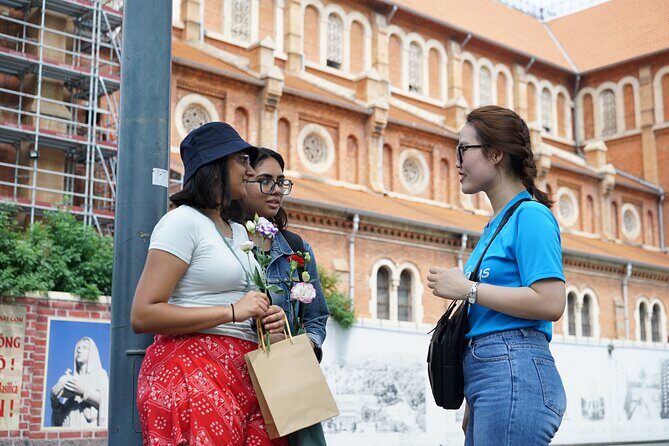
At $14 per person, the price is surprisingly low for a structured tour that covers several major sights. Here’s why it feels like good value in real terms:
- Bottled water is included, which sounds basic until you realize how quickly walking tours run you dry.
- Vietnamese coffee (Ca Phe Sua Da) is included, so you’re not hunting for it mid-route.
- All fees and taxes are included in the tour price.
- Most stops on the route are free admission, with the exception that the Secret Weapons Cellar admission is included as part of the experience.
The walking time is about 3 hours 15 minutes. That’s enough to cover a lot of landmark ground in District 1 without turning it into a full-day ordeal. It also tends to feel comfortable if you start earlier in the day, when the heat is less intense. I like that you can keep the pace human, not gym-class sweaty.
One practical consideration: this tour is weather-dependent. If conditions are poor, you’ll be offered a different date or a full refund. So if you’re planning around rain, keep the forecast in mind the day before.
The route: central sights plus war memory you can actually see

This walk is built around a simple idea: major landmarks first, then the war story in places you can stand inside. The route is mostly classic District 1 territory, which means you’ll have an easy time pairing it with other plans afterward—lunch, museums, or a slow evening stroll.
You’ll also get a steady rhythm. Each stop has a set time, so you get to see important details without feeling rushed. And because multiple stops are free, you avoid the annoying surprise of paying for ticket after ticket.
Stop 1: Notre-Dame Cathedral Basilica of Saigon, fast and photogenic
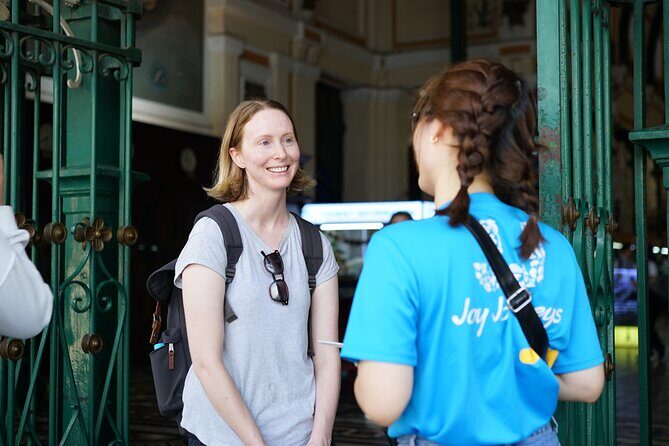
Your first stop is the Notre-Dame Cathedral Basilica of Saigon in the city center. It’s known for its late-19th-century Catholic architecture and it sets the tone for the walk: you’re starting with one of the most recognizable structures in Ho Chi Minh City.
You get about 20 minutes here, and the admission ticket is listed as free. That means you can do the practical things: get a clear view of the façade, look around the immediate area, and take a few photos without feeling like you’re stuck in line or trapped indoors.
A small but real tip: give yourself a couple of minutes to look at details rather than just the big picture shot. Even if you don’t care about architecture, this is one of those places where the design helps you understand why people notice the cathedral from far away.
Stop 2: Saigon Central Post Office, where colonial design meets daily life
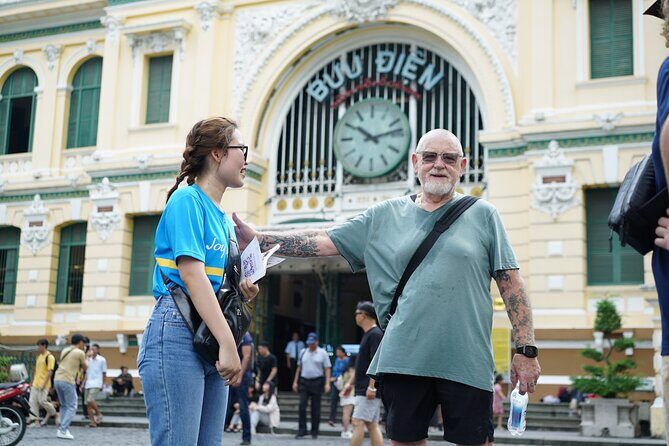
Next up is the Saigon Central Post Office (also known as the Ho Chi Minh City Post Office). It’s another late-19th-century building tied to the French colonial period.
You’ll have about 30 minutes, and the admission ticket is free. This stop is one of the best places to slow down, because post offices are naturally practical spaces. You can observe how people move through the building, how the room feels, and how historic design still fits modern routines.
If you like asking questions, this is a good moment to do it. A student guide can help connect what you see with what it means in the city today—how a historic building can still function as a public space instead of becoming only a museum prop.



Stop 3: Vincom Center and The Last Helicopter sculpture
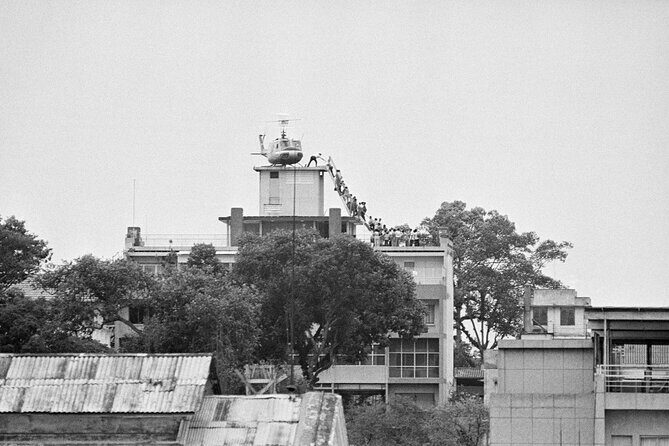
After the big landmark buildings, the route takes a turn toward a Vietnam War-era memorial through art. At Vincom Center, you’ll see The Last Helicopter sculpture, which commemorates the end of the Vietnam War.
The sculpture depicts a Huey helicopter taking off, and it’s described as an iconic symbol in the way it frames the moment. You get about 20 minutes here, with free admission.
This is a useful break in the timeline. You’ve been looking at major civic buildings; now you’re looking at how war memory gets translated into a visual form that sits in an active area of the city. Even if you’re not a history buff, this kind of stop helps you see how the war is not only in textbooks—it’s in what people pass every day.
Stop 4: Independence Palace (Reunification Palace) for the political centerpiece
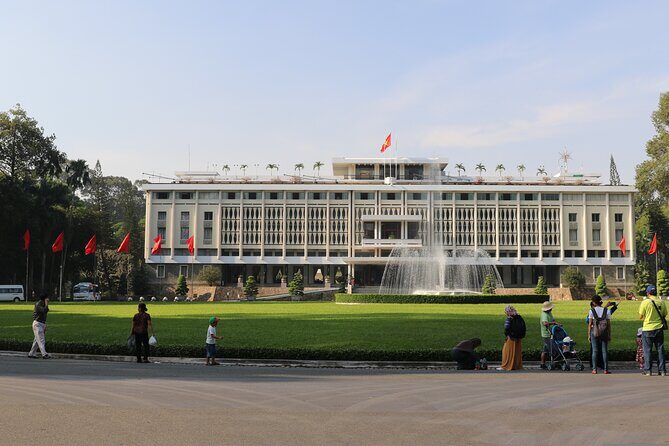
Then it’s Independence Palace, also known as the Reunification Palace. This is one of the core “big sites” on the walk, and it’s tied to the era when the palace served as the home and workplace of South Vietnam’s president.
You’ll spend about 30 minutes here, and the admission ticket is listed as free. That free entry is a big deal because it lets you focus on the experience rather than deciding if it’s worth paying for again.
What I like about this stop in a walking format is that it works as a turning point. Up to now you’ve got architecture and public buildings. Now you’re in a place that anchors political change in a physical setting. If you ask your guide a question here—what this place felt like then versus now—you’ll get a contrast that sticks.
Stop 5: The Venerable Thich Quang Duc Monument, where protest becomes a marker
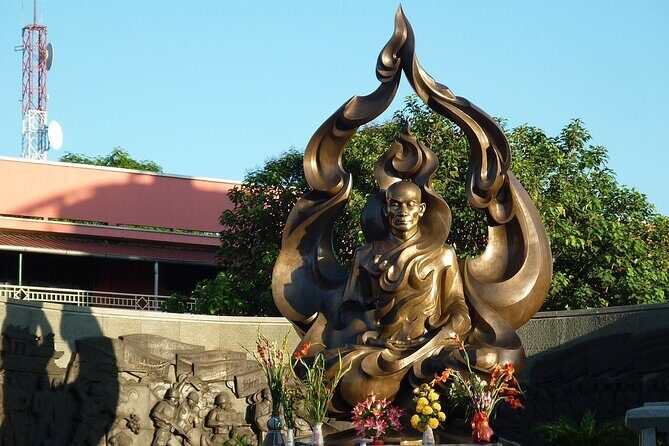
Next you’ll visit the Thich Quang Duc Monument, which commemorates the self-immolation of the monk Thich Quang Duc in 1963. The description notes it was in protest of persecution, and the monument serves as a lasting reminder of that moment.
You’ll have about 30 minutes, and admission is free. This stop needs the right kind of attention. It’s not just another statue photo. Even if you don’t know all the background before you arrive, the guide can help you frame what you’re looking at and why it matters.
One practical consideration: this is the sort of stop where silence—or at least a slower pace—feels respectful. If you want to ask questions, do it, but do it gently and give yourself a minute to take it in first.
Stop 6: The Secret Weapons Cellar, where the Vietnam War story becomes underground
Finally, the walk turns into something more immersive in a literal way: The Secret Weapons Cellar. It’s originally described as tunnels built by the Viet Cong during the Vietnam War. These spaces were used for guerrilla warfare and as a way to transport supplies and weapons without being detected by American and South Vietnamese forces.
You’ll spend about 45 minutes here, and the admission is listed as included. This is the stop many people highlight as a standout, because it’s one thing to hear a war story and another to stand in a space designed to operate under pressure.
A quick note for comfort: tunnels and underground areas can feel cooler or enclosed depending on the conditions. Wear shoes you’re happy to walk in for a longer stretch, and keep your phone handy for photos only if the area allows it.
If you want your guide to explain more than the basics, this is the best place to ask. The location itself gives the story weight, and your guide’s student perspective helps make it understandable without turning it into a textbook.
Included coffee and the best way to use the conversation
The tour includes a cup of Vietnamese coffee: Ca Phe Sua Da. You’ll also get bottled water, which is a simple inclusion but a smart one for a city walk.
Here’s how to make the coffee stop do more than just refill you: use it as your check-in moment. Ask your guide a question that starts with what you can see.
Good question styles:
- What does this neighborhood feel like for locals on an ordinary day?
- Why is this landmark treated as important today?
- What should I read, watch, or try next that feels local rather than touristy?
Some guides like Lucy have been praised for generous time and thoughtful conversations. That’s the real advantage of this format: you’re not limited to answers you can read off a plaque.
What you’ll likely love (and for whom this tour fits best)
This tour is ideal if you want a first pass through District 1 landmarks with a human guide, not a strict lecture. If you enjoy talking to locals and building a mental map through stories, you’ll feel at home quickly.
It also fits well if you value pacing. With a small group, you can move at a comfortable speed, ask follow-ups, and still complete all the key stops.
If you’re the type who likes history but gets bored by long monologues, this is a smart compromise: you still see major Vietnam War sites and monuments, but the explanation comes through personal storytelling. Even when you only know a little going in, the tour helps you connect the dots.
One more plus: the tour format has been praised for being a nice way to explore parts of Saigon that many visitors don’t usually see, and for being a good morning walk option before it gets too hot.
Should you book Joy Journeys’ Saigon walking tour?
I’d book this tour if you want three things at the same time: small-group attention, major District 1 landmarks, and war-era stops explained in plain language by motivated young locals. The price-to-inclusions ratio is hard to beat, especially with free admission at most stops plus coffee and water included.
I’d think twice only if you dislike walking in heat or you want a strictly academic, date-heavy presentation. This tour leans toward conversation and personal perspective, so it’s less about memorizing and more about understanding what Saigon feels like.
If you’re trying to decide between this and a standard big-group sightseeing option, pick this one. It’s built for connection, not crowd management.
FAQ
How much does the Saigon Walking Tour cost?
The price is $14.00 per person.
How long is the tour?
The duration is about 3 hours 15 minutes.
What’s included in the tour price?
Included items are bottled water, all fees and taxes, and coffee and/or tea with Ca Phe Sua Da. The Secret Weapons Cellar admission is also included.
Are the landmark admissions included?
The Notre-Dame Cathedral Basilica of Saigon, Saigon Central Post Office, Vincom Center stop, Independence Palace, and the Thich Quang Duc Monument are listed as free with admission tickets. The Secret Weapons Cellar admission is included.
Where does the tour start and end?
It starts at Joy Journeys, 30A Hồ Hảo Hớn Street, Quận 1, Thành phố Hồ Chí Minh 700000, Vietnam and ends back at the meeting point.
How big is the group?
The tour is described as maximum 6 travelers in the group. The overall activity lists a maximum of 20 travelers.
Do I get a mobile ticket?
Yes, the tour includes a mobile ticket.
What is the cancellation policy if plans change?
You can cancel for a full refund up to 24 hours in advance. The experience requires good weather, and if it’s canceled due to poor weather you’ll be offered a different date or a full refund.